The Claims Payment Chain: Where Money Disappears Between Approved and Received
Approved. That is the word the claims adjuster types, and that is the word the claimant hears. What neither of them sees is the chain that fires next: the payment register entry, the disbursement file, the cheque or EFT or virtual card instruction, the bank clearing event, the GL posting, the month-end reconciliation. Somewhere between “approved” and “received,” the money enters a corridor that belongs to nobody in particular, and that is where it disappears.
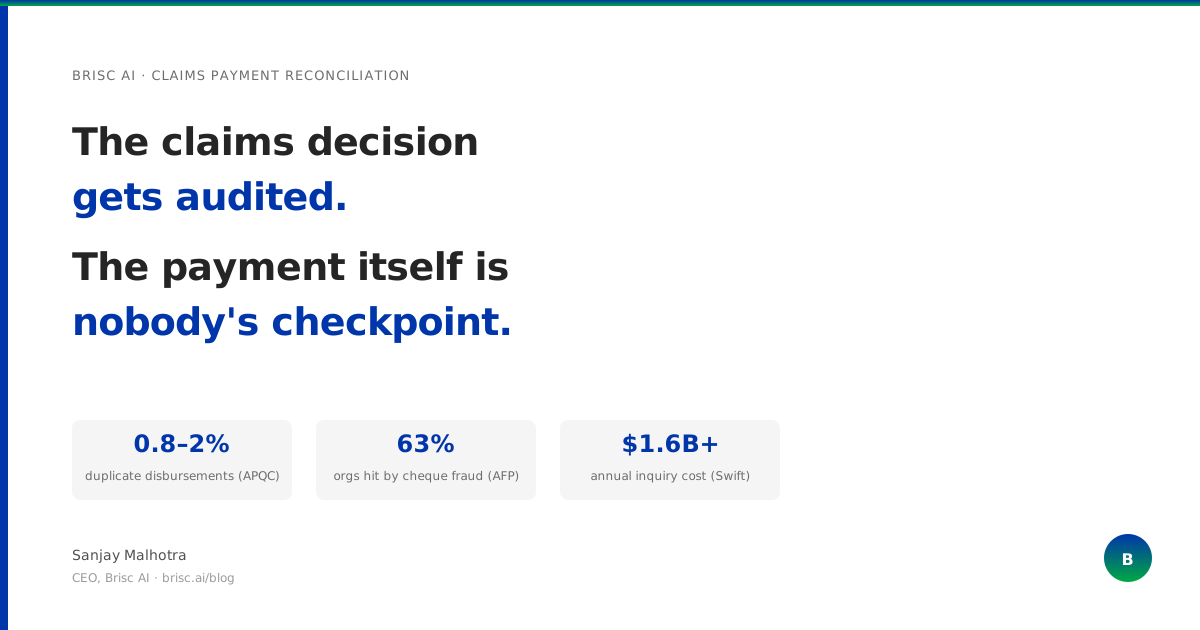
Not stolen. Disappears from view. A payment clears the carrier’s bank account, and nobody on the claims side can confirm it landed in the right hands, on the right claim, for the right amount, without pulling three spreadsheets and a bank statement. The claims decision gets audited, QA’d, reviewed in closed-file studies. The payment itself is nobody’s checkpoint.
Brisc AI builds insurance-native Reconciliation Analysts that match every disbursement back to the claim it belongs to, with the evidence chain attached. The question “did the money land where it should?” gets a provable answer instead of an inference.
The payment chain has owners, but the proving layer does not
Claims payment operations span everything after “approved”: adjudication, payment register, disbursement rail (cheque, EFT, virtual card, push-to-debit), bank clearing, reconciliation, and GL close. Ownership splits across three teams. Claims ops cuts the payment. Treasury owns the bank accounts and positive pay controls. Finance shared services owns escheatment and the close.
Each team reconciles its own layer. None of them answers the claim-level question: did this specific claim’s money reach the right payee, on the right rail, and clear against the right bank line?
That question falls into a gap. And the gap has a measurable cost.
The three-layer tooling landscape, and what none of them proves
The market has built three distinct categories of tool around claims payments, and each one solves a real problem. None of them solves the proving problem.
Payout platforms, One Inc, VPay, Dream Payments, and their peers, execute disbursement at scale. They move money across rails: ACH, real-time payments, virtual cards, cheque-on-demand. They reconcile their own ledger, confirming that every payment instruction they received was executed. The payout platform knows the payment left. It does not know the payment landed against the right claim in the carrier’s books.
Enterprise reconciliation suites, BlackLine, Duco, AutoRek, match generic records across systems. They are powerful horizontal tools. They are not claim-aware. A BlackLine matching rule can pair a bank line to a payment file entry, but it does not carry the claim number, the loss type, the coverage layer, or the adjuster’s approval through the match. The context that makes an insurance reconciliation meaningful is the context these tools do not hold.
Bank controls, positive pay, account reconciliation processing (ARP), and payee-name verification, reconcile instruments. They catch altered cheques and unauthorized debits. They do not match cleared items to claims.
The layer that ties bank line to payment to claim to exception workflow is spreadsheets at most carriers. That is the white space: a proving layer above the rails.
The failure modes are measured, and they compound
Each gap in the proving layer produces a specific, documented failure mode.
Duplicate disbursements go out at a rate of 0.8–2% across industries, according to APQC benchmarking data. No insurance-specific rate is published, duplicate payments hide inside the EY-estimated 7–14% claims leakage pool, and no carrier discloses its own number. Recovery-audit firms find them years later and keep 20–30% of what they recover. The honest position: the first measured period on a carrier’s own data produces the carrier’s own number. That number is almost always higher than expected.
Cheque fraud hit 63% of organizations in 2024, according to the Association for Financial Professionals. Roughly half of claim payments still went by cheque as recently as 2020–21. Every uncashed, unverified, or re-routed cheque is an unresolved item on a claims payment reconciliation, one that ages silently until someone asks where the money went.
“Where is my payment?” inquiries consume 2–10% of payment volumes and cost the financial services industry more than $1.6 billion per year, according to Swift. In insurance specifically, claims-handling delay is the number-one confirmed complaint category in US regulators’ data. Every investigation that starts with “we can see it was approved but can’t confirm it cleared” is a symptom of a broken proving chain.
Escheatment exposure builds in the background. Uncashed claim cheques age into unclaimed-property liability, audit look-back periods reach up to 15 years in some US jurisdictions, and unclaimed property is Delaware’s third-largest revenue source. A carrier that cannot tie its outstanding cheques to specific claims cannot scope its escheatment liability, and the state auditor’s timeline is longer than anyone’s memory.
The unit economics of rails make migration inevitable but don’t solve the proving problem on their own. Cheques cost $2–4 each; ACH transactions cost $0.26–0.50, according to Nacha and the AFP. Moving to digital rails shrinks the cheque-fraud and escheatment tail, but the claim-level matching problem, did this ACH credit land against claim 4471892?, persists on every rail.
Money movement, now reconciled
The structural pattern across every failure mode is the same: a platform moves the money correctly, and nobody proves it arrived correctly at the claim level.
This is the same pattern Brisc solved on the premium side. Premium collection platforms move cash in; Brisc’s Reconciliation Analyst matches every dollar to the policy it belongs to, with the evidence attached. The claims side is the mirror: payout platforms move cash out, and the proving layer matches every disbursement to the claim it belongs to, through the bank.
The architecture works the same way in both directions. The Reconciliation Analyst ingests the payment register, the bank statement, and the payout platform’s settlement file, and matches each cleared item to its originating claim, carrying the claim number, loss type, payee, rail, and clearing date through the match. Exceptions surface the day they occur, not at month-end. The audit trail is not reconstructed after the fact; it is produced as the payment clears.
Brisc’s Reconciliation Analyst maintains 97%+ accuracy on bordereaux reconciliation, and accuracy does not degrade with volume, broker quirks, payer aliases, and netting patterns become permanent institutional memory. Helix Underwriting Partners reports that Brisc removed 80% of their manual labour. Deployment takes 2–6 weeks.
What a proving layer changes
Three operational exposures close when every disbursement carries provable lineage from claim to bank.
The duplicate-payment window shrinks from years to days. When every payment clears against a matched claim, a second payment for the same claim surfaces as an exception on the day it clears, not when a recovery-audit firm finds it three years later and keeps a quarter of the proceeds.
The investigation queue drains. “Where is my payment?” stops being a manual trace through three systems and becomes a lookup. The disbursement, the rail, the clearing date, and the claim are already linked. The 2–10% inquiry rate still generates calls; it stops generating multi-day investigations.
The escheatment pipeline gets scoped. Outstanding cheques tied to specific claims can be aged, followed up, and escheated on a known schedule instead of discovered during an audit. The carrier controls the timeline instead of reacting to a state examiner’s.
Common questions
What is claims payment reconciliation, and why is it different from the payout platform's reconciliation?
A payout platform reconciles its own ledger, confirming that every payment instruction it received was executed on the correct rail. Claims payment reconciliation goes further: it matches each cleared bank item back to the originating claim, carrying the claim number, payee, loss type, and approval through the match. The payout platform proves the money left; claims payment reconciliation proves it landed.
Why do duplicate claim payments happen?
Duplicates arise from re-issued cheques when the original status is unknown, system-of-record mismatches between claims and treasury, manual payment workarounds outside the payment register, and timing gaps between payment instruction and clearing confirmation. APQC benchmarking data puts the cross-industry duplicate rate at 0.8–2% of disbursements. Recovery-audit firms find them years later and retain 20–30% of recoveries.
What does escheatment have to do with claims payments?
Uncashed claim cheques, whether lost, misrouted, or simply forgotten, age into unclaimed-property liability. US jurisdictions impose audit look-back periods of up to 15 years. A carrier that cannot tie its outstanding-cheque inventory to specific claims cannot scope its escheatment exposure or manage follow-up proactively.
How does Brisc's Reconciliation Analyst handle claims payments?
The Reconciliation Analyst ingests the carrier's payment register, bank statements, and payout-platform settlement files. It matches each cleared item to its originating claim with the full evidence chain, claim number, payee, rail, clearing date, and approval reference. Exceptions surface the day they occur. Accuracy holds at 97%+ and does not degrade with volume.
Does Brisc replace the payout platform?
No. Payout platforms execute disbursement, they move the money. Brisc proves the money arrived where it should. The two are complementary: the payout platform's structured payment records carry the claim reference that makes matching cleaner from the start. Brisc is the proving layer above the rails.
How long does deployment take?
Brisc deploys in 2–6 weeks. Day-30 match rates typically reach 80%+, climbing to 92–95% as the system tunes to the carrier's payment patterns, payee aliases, and rail-specific clearing formats.
Is there a published insurance-specific duplicate-payment rate?
No. The APQC 0.8–2% benchmark is cross-industry. Insurance-specific duplicates are embedded in the broader 7–14% claims-leakage estimate and no carrier publishes its own rate. The honest approach is to measure on the carrier's own data, the first measured period almost always reveals duplicates that legacy processes missed.
What accuracy does the Reconciliation Analyst achieve?
Brisc maintains 97%+ accuracy on bordereaux reconciliation, and accuracy does not degrade with volume. Every payee alias, netting pattern, and rail-specific format the system learns becomes permanent institutional memory, it does not reset with staff turnover. --- *Sanjay Malhotra is CEO of [Brisc AI](https://brisc.ai). To see how the Reconciliation Analyst works on your claims book, [request a demo](/demo) or explore the [Bordereaux Reconciliation](/bordereaux-reconciliation) page.* ---